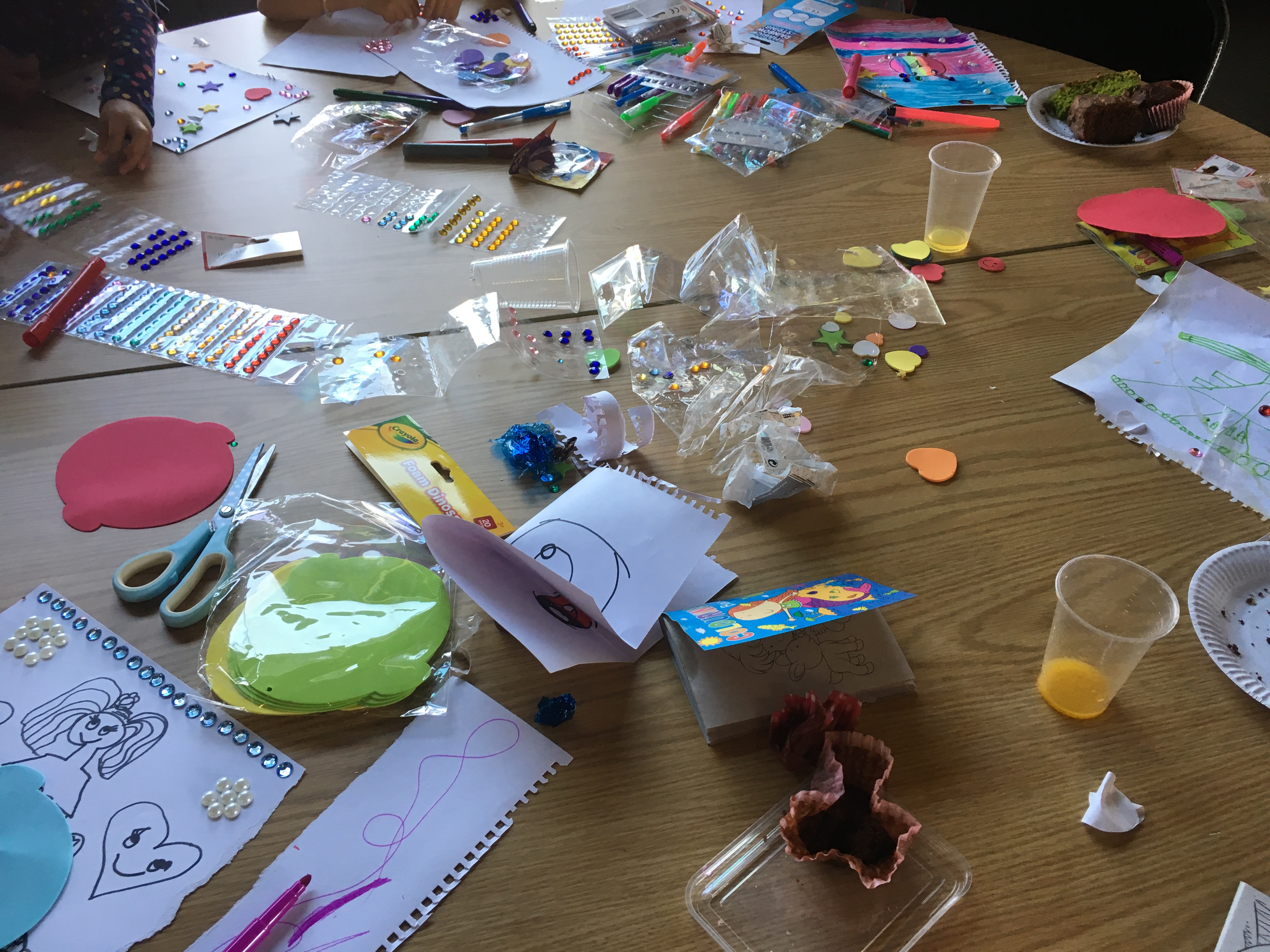

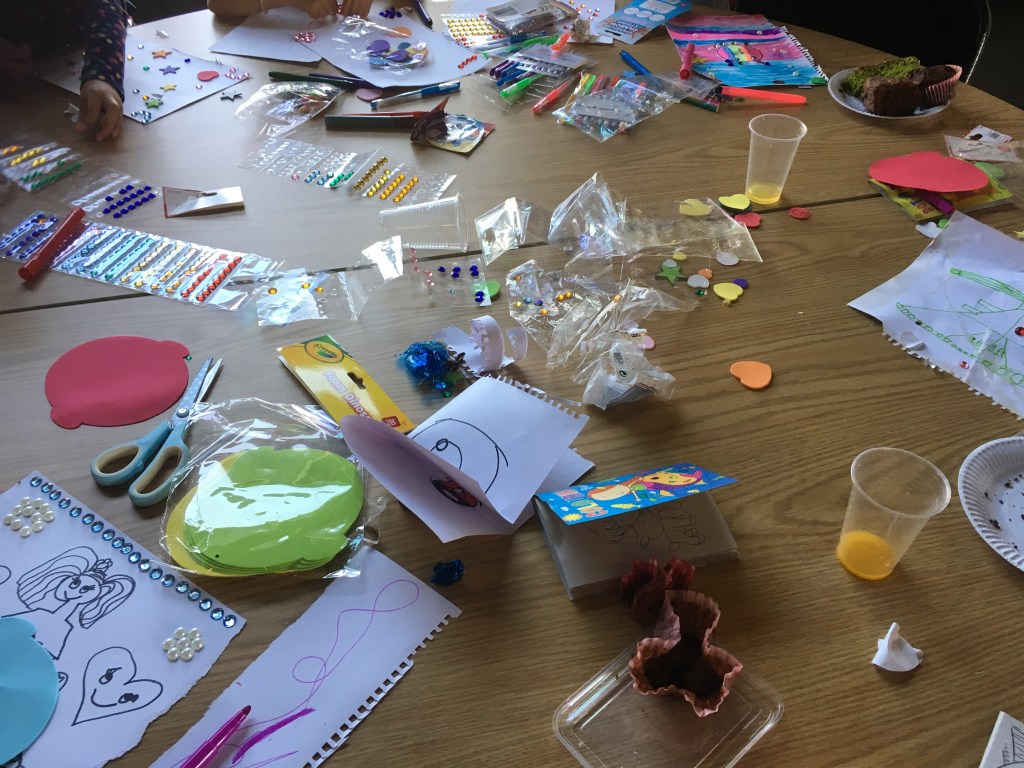
I sometimes describe myself as an ‘eclectic’ qualitative researcher. I’ve been, and remain, open to influences from a range of disciplines and methodological approaches, especially for tackling any challenges I’ve faced along the way. My journey into creative research methods is very much a reflection of who I am as a person and as a researcher. My use of creative methods often reflected the somewhat messy nature of any qualitative researcher – something I captured visually in my field notes too! The photo below shows a table at the end of an interview conducted during a refugee women’s group – the children found my craft bag! In this post I talk about some of the ethical considerations and the practicalities of using creative research methods with asylum seeking and refugee mothers.
At the start of my PhD, people would often ask me about the languages I speak and whether I speak any that might be useful in my research. I always felt a moment of shame as I answered – I am only fluent in one language, English, although I have studied four enough reasonably well and two others in passing. (More than many people born in England, but not compared to the wider world). When, I listed the four languages, Id usually get a response along the lines of “ah, so none that will be really helpful then”. I won’t discuss here, what that reflected about British, including academic, perceptions of asylum seekers and refugees. But I will admit that I was fully aware that only having fluency in English meant I had some ethical and linguistic decisions to make.
While lots of asylum seekers and refugees in the U.K. speak fluent or very good English many do not. There’s a huge range of first languages in this heterogenous group, due to the range of countries of origin and educational levels. I scoured literature to see how other researchers conducted qualitative research interviews with participants who spoke different languages. Some choose to have participants from one specific country of origin only. Some use translators and interpreters, accepting the potential issues of changed or lost meaning with translations. Others conduct all interviews in English, accepting that will exclude those who do not speak good conversational English. There is not a consensus on a ‘correct’ way (quite rightly) but none of the typical choices really felt right for me and my work.
I started reading more literature on participant communication during interviews and encouraging interviewees to talk. I became more and more that creative and visual methods might be a good approach for me. So, I searched to find details of research projects where this had been tried before. I found details of arts-based projects (Caroline Lenette, 2019) and heard a fantastic presentation (Beatrice Tura 2019) on photo elicitation as a participatory visual method with Caribbean participants in London. However, again, neither of those seem to quite fit the bill.
So, I started to piece together my ideas from the reading I had done to consider an approach that would work for me. I approached Dr. Dawn Mannay to discuss my ideas and she listened, made suggestions, and gave me more reading to look at. I then pieced together a plan. I decided to ask my participants to do a drawing/create an image for me, one that represented their experiences. I put together a bag of pens, pencils, stickers, sticky gems and then, a box of small toys. The toys were an idea I had – perhaps the women might prefer to create a scene I could photograph (a mini sandbox)
I then tried my ideas in one of my pilot interviews. This was with a friend. She chose to do a drawing. She absolutely loved the idea. This pilot interview was with second generation of a migrant family, chosen mostly because I wanted to practice my ‘mother to mother conversation’ idea with her (see this blog post for more on that) with someone who had experienced trauma. I also conducted a pilot with a woman who was newly arrived in Wales and who was not confident in her English. So, I could not be sure how the idea would be received by those from other cultures or other individuals. I felt I would be more able to build rapport and trust and have a mother-to-mother conversation without a third-party present and without reliance on an interpreter. I am an ex-ESOL teacher so felt reasonably confident in my skills to communicate with women whose English was less than fluent. However, I also wanted to offer an additional form of communication to my participants, visual communication, in case they felt at all that they could not make their points well enough in English. I thought it would also be an interesting analytical point to explore what women chose to depict visually with what they chose to say. I had no direct precedent in Wales or literature in the U.K. to follow. So, I made decisions that felt ethically right to me as a researcher and that I thought might help me collect in depth, high quality, and interesting data.
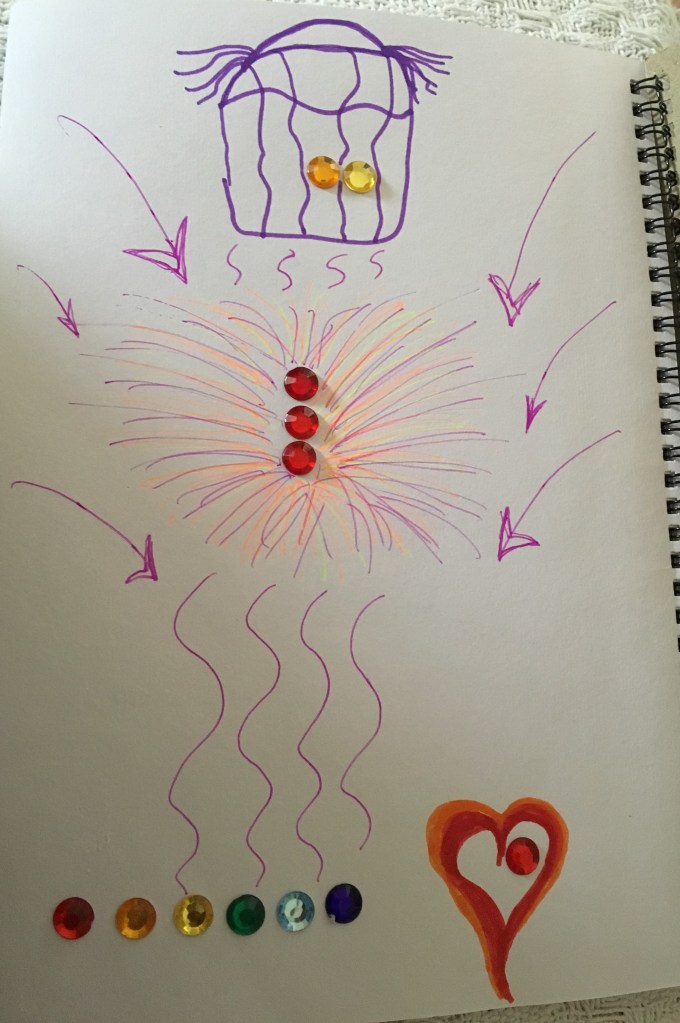
When I conducted my full interviews, most women created an image and were happy to do so. Some weren’t sure what to draw at first but then seemed to get clarity as soon as a pen touched paper. I quickly dropped the idea of toys and photos. It was clear that this would have made the women feel uncomfortable. Instead toys and other arts and crafts materials kept participants children occupied while a mum and I talked.
My participants were largely recruited from refugee support and community groups/organisations. Arts and crafts were generally on offer with most of these groups in some form, be that painting, textiles, crochet or rotating and varied activities. So the idea of creating an image was familiar to all. However, I did need to reassure women I was seeking a representation on paper not a work of art. Some women, did not draw much, favouring sticky objects. Others did simple line drawings, executed in as little as 5 minutes. One spent and hour and a half created a detailed drawing. A minority declined to create anything, with a lack of time given as the key reason rather than an unwillingness. Time was definitely an issue for a couple of women as they had to dash off on school runs. Two women simply declined.
My project was originally designed as a longitudinal study, with three phases of interviews. The creative element was so successful in the first phase that I decided, very early on, to continue it in the second and third phases and try to create visually supported narratives. I planned to try to add some photo elicitation work into the third phase and had ethical approval for all of those. My second phase started well. I spoke with 6 women again and all created another image for me. I chose not to show them their first image again until after they had created their second so as not to influence their second drawing. I wanted to see if I could capture anything temporal through the drawings. I definitely seemed to be doing that and the Covid-19 and lockdowns arrived in the U.K! I will discuss how that affected my work in another blog post. For now, I will finish by saying that the visual data I collected definitely complemented the words spoken by the women. Each image supported or depicted a key area that each woman had conveyed when speaking. Differences between visual representations of experiences reflected differences between verbal representations. However, the images, by their very nature acted as snapshots that reflected the key message the woman wanted to convey, which may have only been part of what she talked about. That became very important when I did my analysis. Whether I chose to include extracts of words or an image to illustrate a point, the drawings helped to guide the focus for the themes I analysed.
Each image, regardless of the skill of its creator was a key and powerful representation of experience and perspective. And my bag of arts and crafts became a key tool in building relationships, rapport, and trust. They contributed to my (partial) insider status in spaces where I could easily have been seen only as an outsider.
 Research Stories